
The extra borrowing implies Jaitley will have extra spending space in the Union Budget for FY19, the last full one before the 2019 general election

To offer additional support at the low end of the income ranges, the Centre will consider a large-scale jump in exemption rates under the old income-tax regime in the vote on account, or interim Budget, according to a senior official in the know. Those will include an extension of the income tax exemption rates close to Rs 7 lakh and additional measures for women farmers.

Ahead of the Budget, global rating agency Standard and Poor's has warned India may not be able to achieve the fiscal responsibility and budget management target of axing fiscal deficit and projected a lower growth of 6 per cent this fiscal.

The ruling Bharatiya Janata Party in poll-bound Karnataka on Friday sought to woo farmers, women and younger generation with a slew of welfare measures in its last budget in the current term, also earmarking Rs 1000 crore towards development and renovation of various temples and maths in the state.
As the duration of the FRBM Act, enacted in 2003, has come to an end, the government would be required to replace it with another law on fiscal consolidation.

'Given the 50 per cent or thereabouts increase in borrowing that has been announced, it is a reasonable estimate to say that at this time, an increase of 1.7-1.8 per cent on the 3.5 per cent budgeted fiscal deficit target is being anticipated,' Chief Economic Adviser Krishnamurthy Subramanian said on Friday.

The government will set up 16 new medical colleges over the next five years.

Finance Minister Nirmala Sitharaman has brought down the budgetary allocation for the fertiliser subsidy for FY21 to Rs 71,309 crore, from the RE of Rs 79,998 crore for FY20, while increasing food subsidy to FCI through "ways and means advance" to Rs 50,000 crore for FY21, from Rs 36,000 crore in RE for FY20, and under the National Food Security Act (NFSA) to Rs 77,982 crore, from Rs 75,000 crore.
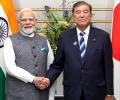
Prime Minister Shigeru Ishiba's sudden resignation after only a year in office has thrown Japan into political turmoil, raising doubts about how the country will handle economic and regional challenges, observes Dr Rajaram Panda.

'Stay disciplined, and remain invested.' 'Volatile times are the best to invest in structural opportunities at the right price.'
Officials in the finance ministry are not happy with credit rating agency Fitch's revision of India's local currency outlook to negative from stable. Officials say Fitch's conclusion that the central government's fiscal deficit will rise to 4.5 per cent of gross domestic product in 2008-09, as against 2.8 per cent in the previous fiscal, is wrong.
The Centre will take a hit of Rs 26,000 crore (Rs 260 billion) in 2005-06 by implementing the twelfth finance commission's proposal of a higher share of central taxes, grant and debt relief to states.


Member of Parliament Rajeev Chandrasekhar feels that the economy today is bankrupt due to big spending towards social welfare programmes such as NREGA.

The Left parties which had raised the issue were not satisfied with his reply and walked out and they were joined by Samajwadi Party.
Vijay Kelkar, who headed the committee on tax reforms, on Tuesday warned that higher economic growth and foreign direct investment flow could not be achieved without hard fiscal reforms.
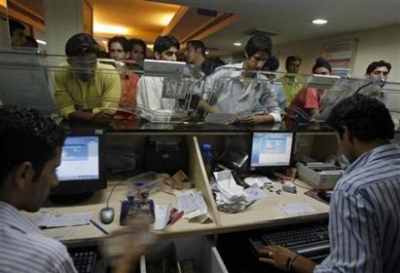
Arun Jaitley addressed a post-Budget press conference.

India's Finance Minister Nirmala Sitharaman has announced an ambitious plan to develop the country's top 50 tourist destinations in a "challenge mode", with the aim of boosting employment-led growth and attracting international visitors. The Ministry of Tourism has received a significant budget increase for 2025-2026, with a focus on enhancing tourism infrastructure, promoting domestic and international travel, and ensuring the safety of tourists, particularly women. The government plans to promote homestays, improve connectivity to tourist spots, and provide performance-linked incentives to states that demonstrate effective destination management. The budget also includes investments in public enterprises, skill development programs, and initiatives to promote medical tourism and spiritual tourism.

Moody's Investors Service, while silent on the sovereign rating on the higher-than-expected fiscal deficit numbers, expressed doubts over attaining the higher revenue targets and divestment realisation as assumed in the Budget. The Union Budget 2021-22 has pegged a fiscal deficit of 9.5 per cent for the current financial year as against the consensus 7 per cent, and 6.8 per cent for 2021-22 with a market borrowing of around Rs 12 lakh crore. It also assumes Rs 1.75 lakh crore to be scooped up from divestment.
'But can it afford to present a scenario within the existing legal framework of fiscal consolidation?', asks A K Bhattacharya.

Finance Minister Nirmala Sitharaman will present her second Budget a little more than a month from now. Like any other FM, Sitharaman will depend on her team of bureaucrats and advisors to frame and present the Budget.
The tug of war between the finance ministry and the Planning Commission over more resources for plan projects worsened, with Planning Commission Deputy Chairman Montek Singh Ahluwalia saying he was keen on getting more money for the 11th Plan.

However, finding the funds to fulfill them will be a herculean task.

The government should have mentioned clearly the specific structural reforms that were responsible for the deviation from the fiscal deficit target by half a percentage point, says A K Bhattacharya.
Vijay Kelkar, advisor to the finance minister, has been entrusted with the new task of preparing quarterly review of the economy as mandated under the Fiscal Responsibility and Budget Management Act.
Finance Minister P Chidambaram said revenue deficits would have to be wiped out first in the economy.

The higher salaries and pension outgo will be equivalent to about one per cent of the GDP.
Booming manufacturing and services sector is likely to push up India's GDP growth to 7.7 per cent in 2006-07, but inflationary pressure may lead to hike in interest rates

Now that the economy is growing at a higher-than-expected rate, it is time to accelerate the pace of fiscal consolidation, and the Budget could be a good starting point, argues Rajesh Kumar.
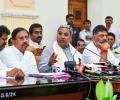
'Karnataka's finances are much healthier than the Union government's, which is indebted to nearly twice the extent of the state.'

The tax base should comprehensively extend over all goods and services up to the final consumer point.
Credibility of fiscal promises is a virtue that no finance minister can afford to lose.
The economic fundamentals were strong enough to ensure 6-6.5 per cent growth in GDP during 2003-04, while fiscal deficit will be under control, D C Gupta, finance secretary said on Friday.

The finance minister could well be on her way to setting a record of achieving the biggest single-year reduction in the government's fiscal deficit, explains A K Bhattacharya.

The macroeconomic environment has changed dramatically for the better.

These are valuable suggestions and one hopes the Budget will make a start on that.
